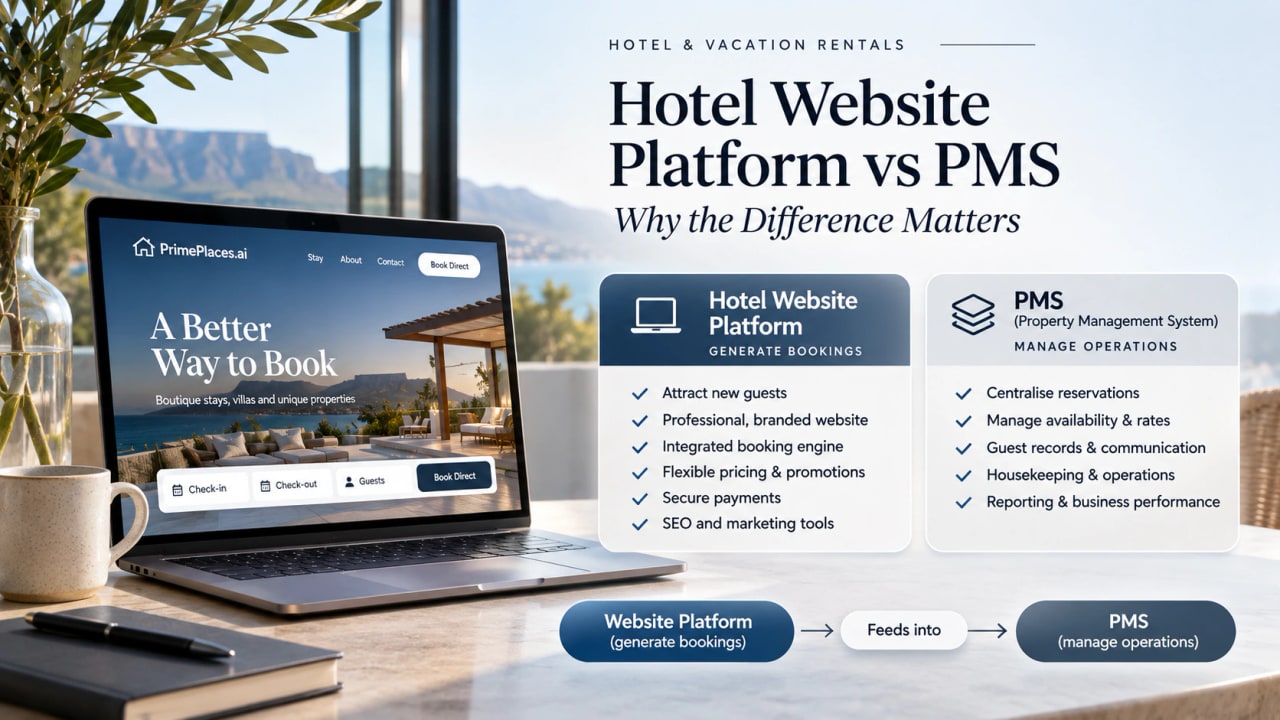
A property management system helps you manage your bookings. A website platform helps you generate them. Understanding that distinction is fundamental to building a successful hotel, guesthouse or vacation rental business.
The hospitality technology market is crowded with property management systems (PMS), channel managers, booking engines and website builders. These products are frequently marketed as interchangeable solutions, despite serving fundamentally different purposes.
For property operators comparing a hotel website vs PMS, the distinction matters. Managing reservations efficiently is important, but so is creating demand, attracting guests and building a business that isn't entirely dependent on third-party booking platforms.
A PMS manages your business. A website platform generates business.
A property management system (PMS) is primarily an operational tool. It helps property operators manage reservations, guest records, room allocations, housekeeping, reporting and other administrative tasks.
Many PMS products also connect with channel managers to coordinate availability and rates across platforms such as Airbnb, Booking.com and Expedia.
Their principal strength is operational efficiency: keeping the business organised as reservations arrive from multiple sources.
A hotel or vacation rental website platform, by contrast, is fundamentally a sales and marketing tool. Its purpose is to establish your own online presence, attract potential guests, convert visitors into paying customers and generate direct bookings.
Your website is effectively another booking channel, but one that you own and control.
That distinction is significant. A PMS helps manage the business you already have. A website and direct-booking platform helps you win more business in the first place. Neither software category guarantees demand: attracting guests still takes marketing, a competitive offer and a good guest experience.
Why a website platform needs more than a booking engine
Creating a successful direct-booking channel involves considerably more than displaying a calendar and accepting reservations.
A properly designed hospitality website platform needs to bring together several essential components:
- Professional website design: Mobile-friendly layouts, attractive photography, detailed property descriptions, amenities and location information that encourage guests to book.
- Search engine visibility: SEO-friendly pages, structured data and fast loading times that help potential guests discover your property through search engines. These support discoverability; they do not guarantee rankings.
- Integrated booking engine: Availability, date selection, pricing calculations and a straightforward reservation process within your own website. Read how a hotel direct-booking engine works.
- Flexible pricing and promotions: Seasonal rates, minimum stays, weekly discounts, early-bird offers, last-minute promotions and promotional codes. Check which options each product supports.
- Secure payments: Payment gateway integration, payment terms and a reliable checkout experience. Our hotel online payments guide explains what to consider.
- Availability synchronisation: Connections to external booking calendars to reduce the risk of double bookings. Calendar feeds update periodically, not instantly; understand the limitations of availability synchronisation.
- Guest management and administration: Guest details, booking confirmations, invoices, cancellation policies, house rules and reservation records.
- Marketing and analytics: Visitor tracking, traffic sources, booking conversions and insights into which marketing activities generate reservations, subject to the tools and consent settings available.
These capabilities work together. A beautiful website without a reliable booking engine cannot convert visitors effectively. An excellent booking engine on a poorly designed website may never attract enough visitors to become commercially valuable.
The website, booking engine and supporting administrative tools need to function as one connected system.
Your website and PMS should complement each other
A website platform and a PMS are not necessarily competing technologies. They serve different functions within the same business.
Consider a guest booking directly through your website.
The website attracts the visitor, presents the property, calculates the price, accepts the booking and processes payment. The reservation can then feed into a PMS where a supported integration exists, becoming part of the property's wider operational workflow.
The PMS may subsequently coordinate housekeeping, room assignments, reporting and other operational requirements.
The website generates the reservation. The PMS helps manage its delivery.
Some PMS providers include website builders and direct-booking engines, and some website platforms offer useful administrative features. There is naturally overlap. The important question is where each product places its emphasis and whether its capabilities meet your business requirements.
For smaller operators, a capable website and booking platform may provide everything needed without a separate PMS. Larger properties with more complex operations may benefit from both.
Before buying, confirm exactly what passes between systems. A calendar-feed connection is not the same as a full PMS integration carrying guest details, payments, room allocations and rates.
Where PrimePlaces.ai fits in
PrimePlaces.ai approaches hospitality technology from the website and direct-booking perspective.
Rather than trying to replace every operational function of a PMS, PrimePlaces.ai focuses on making it straightforward for property operators to establish their own professional booking channel.
Users can import an existing property listing or start with sample content, create a branded website and establish an integrated booking system without having to assemble multiple independent software products.
The platform brings together website creation, property presentation, direct reservations, availability calendars, pricing tools, supported payment gateways and supporting administrative features. Explore the product tour and dashboard guide for a closer look.
It also consolidates availability information from supported external calendars, while reservations originating on third-party platforms continue to be managed through those platforms. PrimePlaces.ai is not intended to replace that operational role of a PMS.
The general integration example above is not a claim that PrimePlaces.ai connects to every PMS. Check your specific requirements against the current features and full system specification before choosing your tools.
The objective is straightforward: give hotels, guesthouses and vacation rental owners the tools to market their properties professionally, accept bookings directly and develop relationships with their own guests.
The commercial difference is what matters
Third-party booking platforms remain valuable distribution channels. They provide visibility, introduce new customers and generate reservations that independent property operators might otherwise struggle to attract.
But relying exclusively on those channels means paying commissions on bookings and remaining dependent on external platforms for customer acquisition.
Your own website creates an alternative. It gives returning guests, referrals and visitors arriving through search engines somewhere to book directly, without marketplace commissions. Payment processing, website subscriptions and other operating costs still apply, but the guest relationship belongs to your business. See our guide to the real costs of commission-free booking systems.
A PMS makes your property business easier to operate. A strong website and booking platform makes it easier for customers to book with you directly.
Both have their place. But if your objective is to build an independent hospitality brand, attract direct bookings and reduce reliance on third-party marketplaces, a professional website and integrated booking platform is not simply an optional addition to your technology stack.
It is your own sales channel.
Start your PrimePlaces.ai website with sample content or an existing listing import, then choose a plan. Subscriptions include a 7-day money-back guarantee. No questions asked. Cancel anytime.